Toxoplasmosis in cats
Jul 28, 2021
Toxoplasma gondii (Toxoplasmosis) in just comb toe mouse spleen mononuclear cells discovered by the French scholar in 1980, belongs to the native biological taxonomy - Apicomplexan - coccidiosis Gang - coccidiosis Head - Sarcocystis Branch - Toxoplasma, body arched, full name Toxoplasma gondii (Toxoplasma gondii). Toxoplasma gondii belongs to opportunistic pathogenic protozoa. When the body's immune function is normal, toxoplasma infection usually does not show obvious clinical symptoms.

Ways of infection of Toxoplasma gondii:
The intermediate host or the terminal host ingests foods containing infected worms (including tachyzoites, bradyzoites, and mature oocysts), including untreated meat products, dairy products, egg products, and drinking water.
Studies have shown that with a very small probability, Toxoplasma gondii can be infected through the mouth, nose, eye conjunctiva, or broken skin or mucous membrane; flies, cockroaches, earthworms, etc. can be used as media for the transmission of Toxoplasma oocysts; arthropods carry oocysts also The meaning of communication.
Clinical manifestations of Toxoplasma gondii:
Whether it develops after infection with Toxoplasma gondii depends on factors such as the virulence of the strain, the number of infections, the route of infection, and the immunity of the host. Cats are poorly sensitive to Toxoplasma gondii, only a few will have clinical symptoms, and the damage to the body is very limited.
Conditions
The worm strains infected by the host are very virulent and fail to produce sufficient immunity.
The host immune function is weak, and the bradyzoites of Toxoplasma gondii in the body may become tachyzoites with vigorous metabolism and rapid proliferation
In cats infected with toxoplasma gondii, the clinical symptoms are mostly related to the central nervous system, visual, respiratory and gastrointestinal systems, including fever, jaundice, shortness of breath, cough, anemia, muscle pain, dyskinesia, hind limb paralysis, etc., and there are also cases of encephalitis, premature birth or abortion.
Cats should be tested for Toxoplasma when they encounter the following conditions
1. A family member who is pregnant or has low immunity
2. Health check after rescuing and adopting the cat
3. The cat is showing signs of toxoplasmosis
Test Item | Test purpose | Sample | Advantage | Limitation | |
Direct Detection
| Eggs detection | Determine whether it is in the discharge period | Fresh dejection | Easy to operate | It is not possible to determine whether a cat has toxoplasma in the tissues outside its gut |
Extraintestinal detection | Determine the presence of Toxoplasma in tissues or body fluids | Blood, bone marrow, cerebrospinal cord, thoracic and abdominal fluid, eye fluid, amniotic fluid, lymph nodes, muscle, etc | Simple operation, can directly determine whether the sample contains toxoplasma | The sample was limited and the positive rate was low | |
DNA hybridization or PCR testing | Determine whether the corresponding sample contains toxoplasma gondii | All the samples in and out of the intestine | High specificity and sensitivity | The operation is complicated and takes a long time | |
Indirect Detection | Antibody test | Determine if cat has been or is currently infected with Toxoplasma gondii | serum | What is the infection stage of the cat as a whole | It is not possible to determine whether the cat is in the deworming phase |
Toxoplasma detection methods are diverse, considering “whether the cat itself is infected with Toxoplasma gondii” and “whether the cat is at risk of infecting Toxoplasma gondii to other animals or humans”, clinically commonly used fecal egg detection and serum antibody detection are combined judge.
· Positive test for fecal eggs
It means that the cat is infected with Toxoplasma gondii and is in the excretion stage. At this time, a serological antibody test is performed. If clinical symptoms occur, medication can be used to relieve them according to the situation; if clinical symptoms do not occur, only medication is needed to inhibit the growth of the worms.
· Negative fecal egg test
It can only show that the cat is not currently in the deworming period and is not harmful to the environment. If you want to determine whether your cat is infected with Toxoplasma gondii, you also need to test for serum antibody IgG and IgM.
1. Both IgG and IgM antibodies are negative: there is currently no Toxoplasma infection and no treatment is required.
2. IgG antibody is positive and the titer is low, IgM antibody is negative: once infected with Toxoplasma gondii, but at this stage it will not cause damage to the body, no intervention is required.
Both IgG and IgM antibodies are positive and have high titers: they are in the active phase of toxoplasma infection, and medications are needed to inhibit their growth to avoid further harm to the cat.

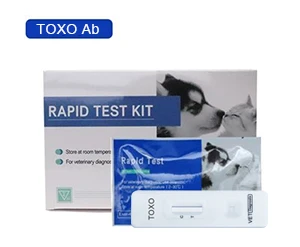
Hangzhou Evegen Biotech Test Kits

Evegen TOXO Test kit
How to keep cats away from Toxoplasma gondii?
Cats are both the intermediate host and the final host of Toxoplasma gondii. Therefore, in terms of prevention, it is necessary to consider both the prevention of the cat itself and the prevention of people living together or other susceptible animals (such as dogs).
Prevent environmental infections
1. Do not drink untreated raw water/tap water directly;
2. Wear gloves when touching the outside soil, sand or cat litter box, and wash your hands with soap and warm water after touching;
3. Inform children of the importance of hand washing;
4. Feed the cat's finished dry food, wet food, or fully cooked/frozen homemade food, avoid directly feeding raw or semi-cooked meat;
5. For cats with confirmed or suspected infection of Toxoplasma gondii, the litter should be cleaned and replaced every day to prevent the oocysts in the litter box from becoming infectious oocysts.
If the family has pregnant women or immunosuppressed people
1. Avoid cleaning and replacing cat litter yourself. If it is unavoidable, wear disposable gloves when handling, and wash your hands with soap and warm water after handling.
2. Cats are kept indoors completely to avoid preying on possible intermediate hosts or insect-preserving hosts such as mice and earthworms.
3. Do not adopt or come into contact with stray cats (especially kittens) whose infection status is unknown, and do not raise new cats during pregnancy.
Whether for cats, humans or other animals, food-borne infection is the main way of toxoplasma infection, and food hygiene should be paid attention to daily. Humans or other animals interacting with cats have a very low probability of infection. If the cat itself is not infected with Toxoplasma gondii, it is impossible to talk about it. Develop good hygiene habits and prevent diseases from entering the mouth. This is to avoid toxoplasma infection. The best way!