Why Testing for One GI Pathogen in Cats Isn't Enough
Jul 06, 2026
Let's be honest-gastrointestinal cases make up a solid chunk of daily feline practice. Vomiting, diarrhea, lethargy, weight loss. The symptoms look similar on paper, but what's actually going on inside can be completely different from one cat to the next.
I still remember a three-month-old Ragdoll that came in a few years back-severe diarrhea, vomiting, dull mentation. Standard protocol: check for panleukopenia first. Negative. Then ran coronavirus-weakly positive. Started supportive care, but two days later, no real improvement. Finally sent off a fecal PCR for parasites, and there it was-Giardia. The whole time, we'd been looking in the wrong direction.
That case stuck with me. If we'd only tested for the "usual suspects," we'd have kept treating the wrong thing.
Symptoms Can Be Deceiving
I've seen it over and over-early-stage feline panleukopenia looks almost identical to mild coronavirus enteritis, and both can mimic a Salmonella or Campylobacter infection. In kittens especially, the gut barrier is fragile. A viral infection weakens the mucosa, and before you know it, bacteria or protozoa move in as secondary players.
A 2021 retrospective review I came across found that in shelter populations, up to 30–40% of kittens with diarrhea were co-infected with two or more enteric pathogens. If you only run a single test, you're seeing maybe half the picture-and treating based on that is a gamble.
What Should We Be Looking For?
In practice, a comprehensive screen typically covers these six:
Feline Panleukopenia Virus (FPV) – highly contagious, often fatal in unvaccinated kittens. Non-negotiable in any sick kitten workup.
Feline Coronavirus (FCoV) – usually causes mild GI signs, but nobody wants to miss the rare case that mutates into FIP down the line.
Giardia – a protozoal parasite that causes chronic or intermittent diarrhea; surprisingly common and often overlooked.
Salmonella – zoonotic, so treating it isn't just about the cat-you have to warn the owner about hygiene too.
Clostridium perfringens – associated with enterotoxin-mediated diarrhea; responds well to targeted antibiotics once identified.
Campylobacter – one of the most frequently isolated bacteria in young cats with acute enteritis.
Together, these six cover the vast majority of infectious diarrheas we see in general practice. That said, I don't run the full panel on every single diarrheal case-but there are situations where I strongly recommend it:
Newly adopted cats with unknown backgrounds.
Multiple cats in the same household developing GI signs around the same time.
Cases that haven't responded to symptomatic treatment within 48–72 hours.
Kittens with rapidly progressing illness, where narrowing the differential quickly matters most.
Why a Multiplex Approach Makes Sense Day-to-Day
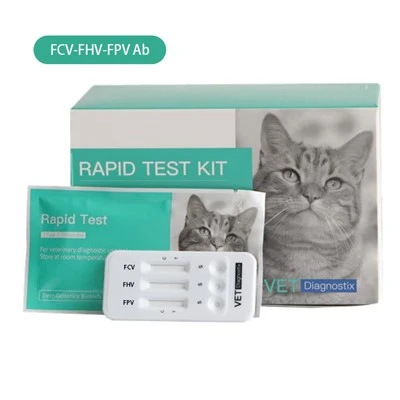
We've been using a combination rapid antigen test in our clinic-one fecal swab, six results in about 10 minutes. Compared to sending out individual tests to an external lab, the difference is noticeable.
First, speed. Previously, we'd wait anywhere from 24 hours to three days for results. In that window, we're treating blind. Now, I can have a direction before the owner leaves the exam room. That changes the conversation entirely.
Second, co-infections get caught. Last month, we took in a litter of four stray kittens-three had diarrhea. The combo test showed two were positive for both FPV and Giardia, while the third only had Campylobacter. If we'd just run FPV alone, that third kitten would have been mismanaged, and we'd have missed the parasitic component in the other two.
Of course, rapid tests aren't flawless. Sensitivity is slightly lower than PCR, especially with weak positives. In those cases, I usually correlate with clinical signs and sometimes confirm with a reference lab. I see these tests as triage tools-they give you a solid direction, not a final verdict.
Personal Take
I'll be upfront-the combo panel costs more than a single test. But in my experience, the real cost is diagnostic time and treatment adjustment. For a sick kitten, knowing the likely pathogen on day one versus day three can mean fewer days of IV fluids, less hospitalization, and a faster recovery. In multi-cat environments, that early information also helps with isolation decisions-which cats to separate, which disinfectants to use, whether to vaccinate contacts sooner.
Nowadays, unless cost is a major concern for the owner, I usually recommend the six-pathogen panel for any undifferentiated diarrheal case. And honestly, sometimes everything comes back negative-and that's useful too. It lets me pivot more confidently toward food intolerance, inflammatory bowel disease, or other non-infectious causes without second-guessing.
At the end of the day, these tests are tools, not replacements for clinical judgment. A positive or negative result is just one piece of the puzzle. The rest comes from a thorough history, a good physical exam, and paying attention to the details the owner shares. But having that one piece early on? That makes a real difference in how I practice.
--A true experience of a veterinarian friend